

Am I a Candidate for LASIK? A Complete Eligibility Checklist Before You Decide
2 Jul 2026
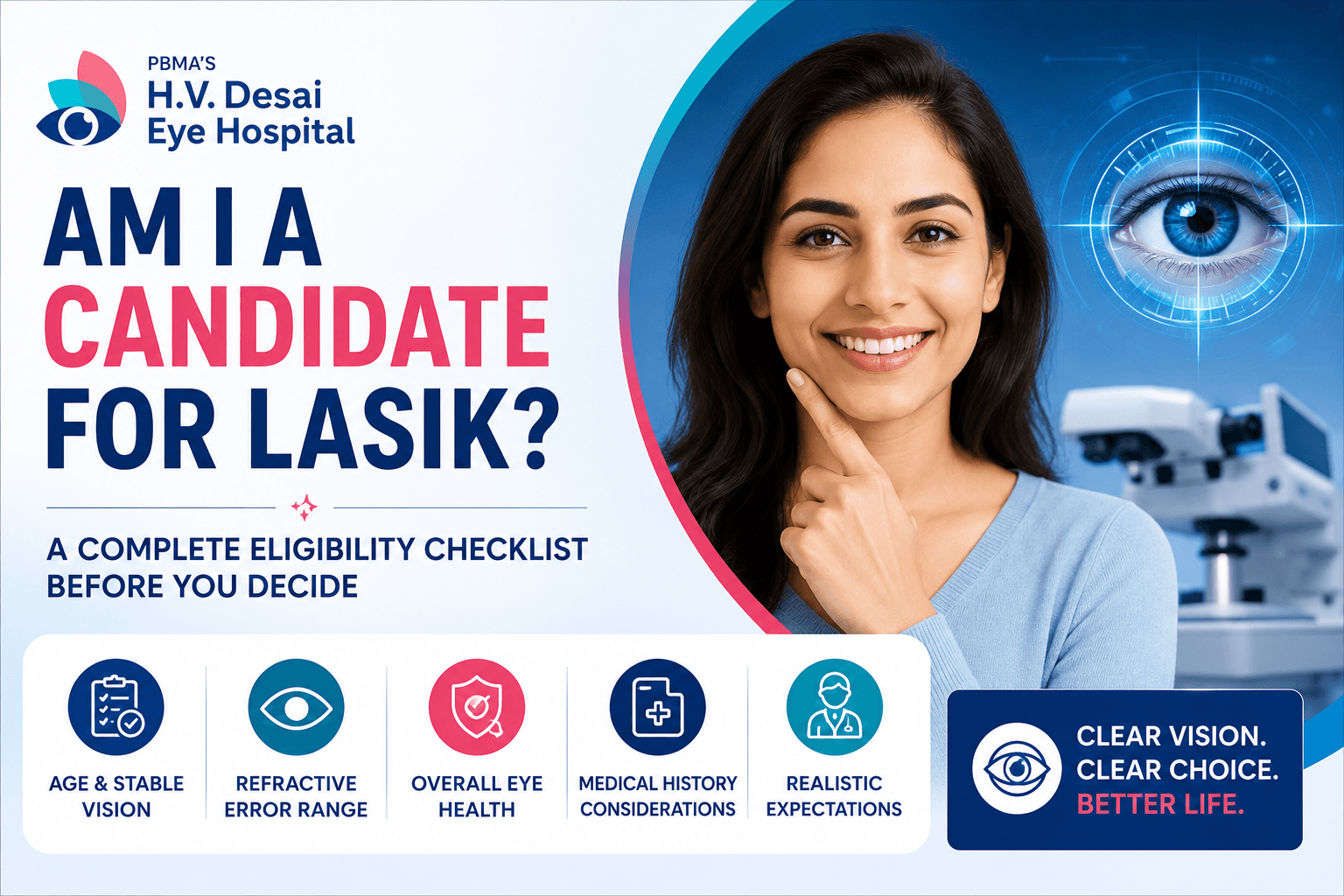
Am I a Candidate for LASIK? A Complete Eligibility Checklist Before You Decide
LASIK has changed how millions of people live, work, and play, but it is not the right answer for everyone. The most common question we are asked at the H.V. Desai LASIK Centre is also the most important: am I a candidate for LASIK? The answer depends on more than just your spectacle power. It involves your age, the stability of your prescription, the thickness and shape of your cornea, your general health, your lifestyle, and your expectations from surgery.
This guide gives you a clear, honest checklist to help you understand whether LASIK is likely to be right for you. It is not a substitute for a formal evaluation, but it will help you walk into your consultation better informed and ready to ask the right questions.
What Determines LASIK Eligibility?
LASIK reshapes the cornea using a precise laser to correct refractive errors. For it to be safe and effective, several conditions need to be met. The eye must be healthy, the prescription must be stable, the cornea must have enough tissue and the right shape, and the rest of your body must be in a state that supports healing. Eligibility is decided not on any single factor but on the full picture, which only a detailed pre-LASIK evaluation can reveal.
The LASIK Eligibility Checklist
1. Your Age
You should be at least 18 years old. Most surgeons prefer that you are 21 or above, because spectacle power tends to keep changing during the teenage years and early twenties. There is no strict upper age limit, but after the age of 40 most people begin to develop presbyopia. LASIK can still be performed, often with monovision planning, but the conversation about glasses for reading later on becomes important.
2. Stable Spectacle Power
Your prescription should have been stable for at least 12 months. A small change of up to 0.25 to 0.50 dioptres is usually acceptable. If your power is still changing, performing LASIK now means your vision will drift again and the results will not last.
3. Refractive Error Within the Treatable Range
LASIK typically corrects:
Myopia (short-sightedness) up to about -10.00 D
Hyperopia (long-sightedness) up to about +4.00 D
Astigmatism up to about 4.00 D
Very high powers beyond these ranges may be better treated with SMILE, ICL, or refractive lens exchange. The right choice is made after detailed evaluation.
4. Healthy Cornea of Adequate Thickness
The cornea must be thick enough to allow the laser to reshape it safely while leaving a healthy residual base. A typical minimum thickness is around 480 to 500 microns, although this varies with the prescription. Detailed corneal topography is also essential to rule out keratoconus, a condition where the cornea is too irregular for LASIK.
5. No Active Eye Disease
LASIK is not advisable in the presence of:
Keratoconus or other corneal ectasia
Severe dry eye
Active eye infections or inflammation
Uncontrolled glaucoma
Significant cataract
Retinal detachment or other unstable retinal disease
Many of these can be treated first, after which LASIK may become an option.
6. Good General Health
Certain conditions can affect healing and outcomes. Your surgeon will discuss whether LASIK is right for you if you have:
Uncontrolled diabetes
Autoimmune diseases such as rheumatoid arthritis or lupus
A history of poor wound healing
Conditions or medications that suppress immunity
7. Not Pregnant or Breastfeeding
Hormonal changes during pregnancy and breastfeeding can shift your spectacle power. LASIK is best postponed until at least three to six months after you stop breastfeeding.
8. Realistic Expectations
LASIK aims to reduce or eliminate your dependence on glasses for most everyday activities. Most patients achieve 6/6 vision or close to it. Some may still need glasses for fine print after the age of 40 due to presbyopia, or for night driving in rare cases. Going into surgery with realistic expectations leads to the highest satisfaction.
Quick Self-Check: Are You Likely to Be Eligible?
You are likely to be a strong candidate for LASIK if you can answer yes to most of the following:
I am at least 21 years old
My spectacle or contact lens power has been stable for at least a year
I have no significant eye disease or chronic eye infections
I am in good general health
I am not pregnant or breastfeeding
I am tired of depending on glasses or contact lenses
I am willing to follow post-operative instructions carefully
If any of these do not apply to you, LASIK may still be possible, or an alternative procedure may suit you better. Only a comprehensive screening can give you a definite answer.
What Happens During a LASIK Screening?
The pre-LASIK evaluation is the single most important step in the LASIK journey. At H.V. Desai LASIK Centre, the screening typically includes:
Detailed history of your spectacle power, contact lens use, eye health, and general health
Visual acuity testing for distance and near
Refraction to confirm your current prescription
Corneal topography to map the surface of your cornea
Pachymetry to measure corneal thickness
Wavefront analysis for high-precision treatment planning
Pupil size measurement
Dry eye assessment
Examination of the front and back of the eye
Detailed counselling on the most suitable procedure for your eyes
Contact lens wearers must stop using soft lenses for at least 5 to 7 days, and rigid gas-permeable lenses for 2 to 4 weeks, before the screening. Lenses temporarily change the shape of the cornea and can give misleading results.
If LASIK Is Not Right for You, What Are the Alternatives?
PRK (Photorefractive Keratectomy)
A good option when the cornea is too thin for LASIK or when the patient is in contact sports or high-impact occupations. Recovery is slower than LASIK but the final results are equally reliable.
ICL (Implantable Collamer Lens) / IPCL
Preferred for very high refractive errors, very thin corneas, or patients with dry eye who are not suitable for laser surgery. A biocompatible lens is implanted inside the eye to correct vision without removing any corneal tissue.
Refractive Lens Exchange
Often considered for older patients above 40 who also have early cataract or significant presbyopia. The natural lens is replaced with an advanced multifocal or extended depth of focus lens.
Common Reasons Patients Are Found Unsuitable for LASIK
Unstable spectacle power that is still changing
Cornea too thin for safe laser correction
Early signs of keratoconus on corneal topography
Severe dry eye that needs treatment first
Very high refractive error beyond LASIK's range
Active eye infection or inflammation
Pregnancy or breastfeeding at the time of evaluation
Being found unsuitable for LASIK is not the end of the road. In most of these cases, a safer and equally effective alternative is available.
Frequently Asked Questions
Can I have LASIK if I have dry eyes?
Mild dry eye is usually not a problem and can be managed before and after surgery. Severe dry eye may need to be treated first or may make SMILE a better option.
Can I have LASIK if I have thin corneas?
Not always. If your corneas are below the safe thickness for, PRK, or ICL may be considered instead.
Is LASIK safe if I am diabetic?
Yes, provided your blood sugar is well controlled and there are no diabetic changes in the retina. Uncontrolled diabetes is a reason to delay surgery.
I have a very high power. Can I still have LASIK?
Possibly, depending on the exact value, corneal thickness, and shape. For very high powers, ICL is often a better option than LASIK.
Can I have LASIK after the age of 40?
Yes. The procedure remains safe, but you should understand that you will still need reading glasses for near work after presbyopia sets in, unless monovision or a multifocal solution is planned.
How accurate is the screening?
Modern screening with corneal topography, pachymetry, and wavefront analysis is highly accurate. It is designed to identify even subtle reasons why LASIK may not be the best option for a particular patient.
Why Choose H.V. Desai LASIK Centre
Trusted name in Pune, backed by H.V. Desai Eye Hospital's legacy of care
Detailed pre-LASIK evaluation with advanced diagnostic technology
Honest, transparent counselling on whether LASIK is right for you
Full range of refractive surgery options including Femto LASIK, Contoura, SMILE, PRK, and ICL
Experienced refractive surgeons with proven outcomes
Clear pricing and dedicated post-operative care
A team that recommends LASIK only when it is truly the best option for you
Book Your LASIK Eligibility Consultation
The simplest way to know whether you are a candidate for LASIK is to schedule a comprehensive screening. Within a single visit, you will know exactly where you stand, which procedure suits your eyes best, and what your path to glasses-free vision looks like. Book your consultation at the H.V. Desai LASIK Centre in Pune today.
H.V. Desai LASIK Centre, Pune