

What Happens After LASIK? A Day-by-Day Guide to Recovery and Life Without Glasses
13 Aug 2026
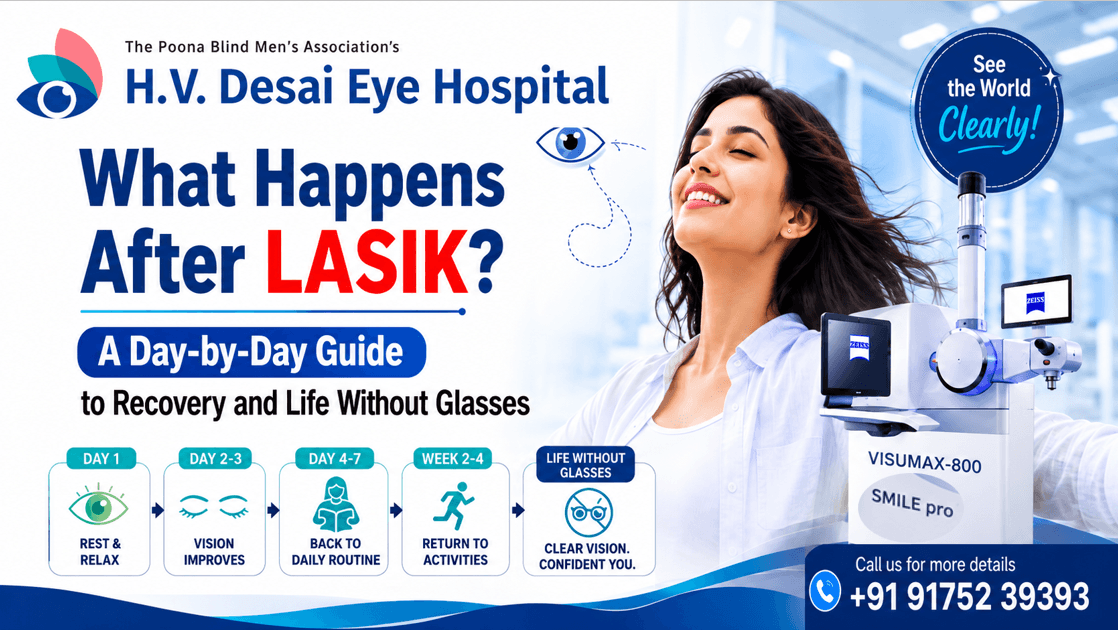
What Happens After LASIK? A Day-by-Day Guide to Recovery and Life Without Glasses
Focus Keyword: LASIK recovery time
Secondary Keywords: life after LASIK, LASIK aftercare, LASIK side effects, LASIK healing timeline, back to work after LASIK, LASIK Pune
Meta Title: LASIK Recovery Timeline | What to Expect After LASIK | H.V. Desai LASIK Centre
Meta Description: Wondering what recovery after LASIK is really like? Day-by-day timeline, aftercare tips, and honest answers about life after LASIK. H.V. Desai LASIK Centre, Pune.
So you have been thinking about LASIK. You have probably watched a few videos, read a few articles, and maybe even booked a consultation. But the one thing that keeps holding you back is a very simple, very reasonable question: what actually happens after the surgery?
How much time will you need off work? Will it hurt? When can you look at your phone? When will you know if it worked? And what does life really look like when you no longer reach for your glasses first thing in the morning? Let us walk through it together, in plain language, day by day.
The Big Picture: How LASIK Recovery Actually Feels
Here is the short version. LASIK recovery is faster and easier than most people expect. The surgery itself is over in about 10 to 15 minutes for both eyes. You go home the same day. Most patients see clearly enough to notice a huge difference within 24 hours. The first day is a bit uncomfortable, the first week has a few rules to follow, and by the end of the first month you have essentially settled into your new normal.
What follows is a realistic timeline of what to expect. Everyone heals at a slightly different pace, but this gives you a good sense of the journey.
The Day of Surgery
Before You Come In
You will have already had a detailed pre-LASIK evaluation, and your surgeon will have confirmed the exact procedure being done. On the day itself, come in a comfortable T-shirt, do not wear any make-up, perfume, or aftershave, and arrange for someone to accompany you home.
The Procedure
You will be seated in a comfortable chair and asked to lie down under the laser. Numbing eye drop go in first, so you will not feel any pain. Your eyes will be gently kept open with a small eye clip. You will be asked to look at a target light. The laser does its work in seconds per eye. You will hear some clicking sounds and see lights, but no pain, no sharp objects, and no bleeding. Both eyes are usually treated in the same sitting.
Right After Surgery
You will rest for about 15 to 20 minutes and then be examined by your surgeon. Your vision will already feel clearer than before, though it may look a bit hazy, as if you are looking through water or a fogged-up glass. This is completely normal.
Going Home
You will be given a set of protective goggles or dark glasses, along with a prescription for eye drops and clear written instructions. You should not drive yourself. Once home, the best thing you can do is close your eyes and sleep for a few hours. Really. This one nap makes a huge difference to how the rest of the day feels.
The First 24 Hours
Mild burning, watering, and a sandy feeling in the eyes for the first 4 to 6 hours
Light sensitivity and a preference for dim rooms
Blurred, dreamy vision that clears steadily
You may feel the urge to rub your eyes; please resist it
Use your prescribed eye drops on the schedule you were given
Wear the protective shield while sleeping
No screens, no reading, no cooking near steam or splashes
Most people find that by the next morning, they wake up already able to see the ceiling clearly, without glasses. That first moment tends to be the one nobody forgets.
Day 1: The Next-Day Check-up
You will come in for a quick check-up the day after surgery. Your surgeon will examine your eyes to make sure everything is healing well. Vision is usually already sharp enough to legally drive, though driving is still avoided for a couple of days. Most people describe day 1 as a mix of amazement (I can actually see!) and some residual dryness or grittiness.
You can now watch television or use your phone in short spells, take gentle walks, and get back to most normal activities at home.
Days 2 to 7
Vision continues to sharpen day by day
Most desk-based professionals return to work by day 2 or day 3
Screen time is fine in reasonable stretches, with breaks and lubricating drops
Sunglasses outdoors are important during this week
No swimming, no dusty environments, no eye make-up yet
Avoid rubbing your eyes even if they itch
Continue the prescribed drops on schedule
It is common to notice mild dryness, some glare around lights at night, and occasional watering during this week. All of these settle down as the eye heals.
Weeks 2 to 4
Vision is stable and clear during the day for almost all activities
Dryness continues to reduce, but keep using lubricating drops as advised
Night vision keeps improving; glare around headlights becomes less noticeable
Eye make-up can usually be restarted after two weeks, based on your surgeon's advice
Gentle sports and gym workouts are usually allowed
Swimming and contact sports are avoided for at least four weeks
Month 1 to Month 3
By this stage, most patients feel fully back to normal. Vision is crisp and stable through the day. Any residual dryness is usually manageable with occasional drops. Follow-up visits are scheduled at set intervals to make sure everything is settled and stable. You are cleared for swimming, contact sports, and all normal activities by the end of this window, based on your surgeon's assessment.
Beyond Three Months: Life After LASIK
This is the part people rarely talk about, but it might be the most important. Once you have adjusted to seeing without glasses, small everyday moments become new experiences. You wake up and see the time on the clock. You step out of the shower and can still see. Swimming, running in the rain, riding a bike, playing with your child, taking a nap on a flight, none of these needs an accessory anymore.
Most patients enjoy stable, clear vision for years. The most common change over the long term is presbyopia, which naturally develops after the age of 40 and may make you need reading glasses for very small print, regardless of whether you had LASIK. LASIK does not accelerate this; it happens to everyone.
What Are the Side Effects of LASIK?
Being honest is important. Here is what may happen and how it is managed:
Dry Eyes
The most common side effect. Almost everyone has some dryness for a few weeks to a few months. Lubricating drops handle this well. Rarely, dryness persists longer and needs specific treatment. Your pre-op assessment identifies patients at higher risk of this.
Glare and Halos at Night
Some patients notice halos around lights at night in the first few weeks. These usually settle down and rarely persist beyond a few months.
Temporary Fluctuation in Vision
Some days your vision may feel sharper than others in the first few weeks. This is normal and settles as the cornea completes healing.
Under- or Over-Correction
In a small percentage of cases, the correction is not perfect. This can usually be adjusted with an enhancement procedure after a few months, if needed.
Very Rare Complications
Serious complications are uncommon with modern LASIK, especially when the pre-op evaluation is thorough. This is exactly why the screening visit is taken so seriously.
Aftercare Do's and Don'ts
Do
Use every eye drop exactly on the schedule you were given
Wear the protective shield at night for the first week
Wear sunglasses outdoors, even on cloudy days
Attend every follow-up appointment
Sleep as much as possible in the first 24 hours
Stay hydrated and eat well
Don't
Do not rub your eyes for at least a month
Do not splash water directly onto your eyes for the first few days
Do not swim for at least four weeks
Do not use eye make-up for at least two weeks
Do not go into dusty or smoky environments in the first two weeks
Do not skip drops just because your eye feels fine
Common Questions People Ask Us
Will LASIK hurt?
No. The procedure is painless because of numbing drops. Afterwards, you may have some mild burning or discomfort for a few hours, and that is about it.
How soon can I go back to work?
Most desk-based professionals return to work in 2 to 3 days. Jobs involving heavy dust, chemicals, or physical labour may need a longer break.
When can I look at my phone?
Short glances from the next day, longer sessions from day 2 or 3. Use lubricating drops liberally and take frequent breaks.
When can I drive?
Usually 2 to 3 days after surgery, once your surgeon confirms your vision is clear enough and steady.
Can I fly after LASIK?
Short flights are usually fine after a couple of days. Long-haul flights are best planned at least a week later. Cabin air is drying, so keep lubricating drops and hydration handy.
Will I need reading glasses later in life?
Very likely, once you cross 40 to 45. This is due to presbyopia, not LASIK. It happens to everyone eventually.
Can the vision correction wear off?
For most people, LASIK results are stable for years or decades. In rare cases where there is a small regression, an enhancement procedure can fine-tune vision.
Is it worth it?
This is the question every patient answers for themselves. What we hear most often at follow-up visits is a simple: I wish I had done this years ago.
Why Choose H.V. Desai LASIK Centre for Your LASIK Journey
Trusted name in Pune, backed by H.V. Desai Eye Hospital's legacy
Thorough pre-LASIK evaluation to identify the safest procedure for your eyes
Full range of options including Femto LASIK, SMILE, PRK, and ICL
Experienced refractive surgeons and modern technology
Detailed aftercare instructions and dedicated post-operative follow-up
Honest counselling: we recommend LASIK only when it is right for you
Ready to Start Your LASIK Journey?
The best way to answer all your questions is a proper consultation. In a single visit, you will know whether LASIK suits your eyes, which procedure fits you best, and what your personal recovery timeline looks like. Book your LASIK consultation at H.V. Desai LASIK Centre in Pune and take the first step towards glasses-free living.
H.V. Desai LASIK Centre, Pune
Call: +91 95271 77776|Email: lasik@hvdeh.org|Website: www.hvdesailasik